Common Mistakes Students Make In Project Introductions And How To Avoid Them
Writing a strong academic project introduction requires more than simply presenting a topic. The introduction establishes the background, research problem, purpose, objectives, significance, and direction of the study. In many undergraduate and postgraduate projects, weaknesses in the opening chapter can affect how supervisors and examiners perceive the quality and relevance of the entire research work.
Academic writing research consistently shows that clarity, logical organization, appropriate evidence, and accurate citation are essential characteristics of effective scholarly communication. A well-developed introduction therefore needs to move logically from the broad research context to the specific problem the study intends to investigate.
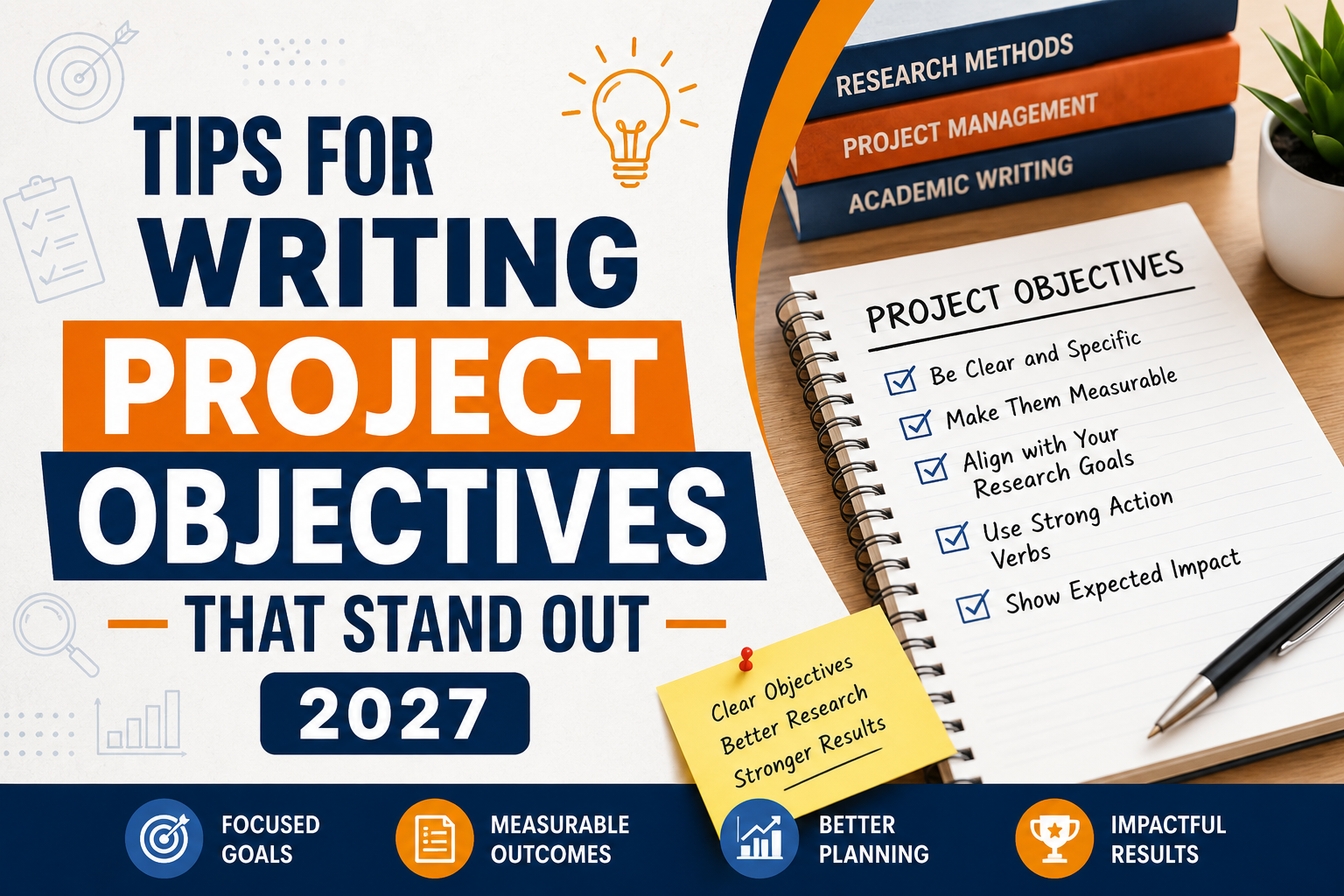
CHECK OUT:Tips For Writing Project Objectives That Stand Out 2027
1. Being Too Vague About the Research Topic
One of the most common mistakes students make is beginning with broad statements that do not clearly identify the research focus. Statements such as “Education is very important in society” or “Technology has changed the world” may be true, but they provide little evidence about the specific problem being investigated.
A stronger introduction progressively narrows the discussion. For example, a project on social media and academic performance should establish the broader issue before identifying the particular population, location, variables, or relationship being examined.
Empirical evidence is particularly important at this stage. Instead of making unsupported generalizations, students should use findings from peer-reviewed studies, official statistics, institutional reports, and reputable databases to demonstrate the scale or relevance of the problem.
How to avoid it
Clearly identify:
- The general subject area.
- The specific research problem.
- The population or setting being studied.
- The major variables or concepts.
- The purpose of the research.
A reader should be able to understand the direction of the project within the first few paragraphs.
2. Failing to Establish the Background of the Study
Another frequent problem is moving directly into the research problem without explaining its context. Academic research is rarely conducted in isolation; it normally responds to an existing problem, knowledge gap, policy issue, or practical challenge.
A good background section should explain what is already known, what has changed, what evidence exists, and what remains uncertain. For example, if a project investigates unemployment among graduates, the introduction could discuss graduate unemployment trends, labour-market conditions, relevant government policies, and previous empirical findings before narrowing the discussion to the specific study area.
The use of current statistics can make the background substantially stronger. However, statistics should always be attributed to reliable sources and presented with their relevant year, population, and geographical scope.
How to avoid it
Build the background from general to specific:
Global context → National context → Local context → Specific problem → Research gap
This structure helps demonstrate why the study is necessary rather than simply stating that the topic is important.
3. Making Claims Without Empirical Evidence
A research project should not depend heavily on unsupported claims. Statements such as “many students perform poorly because of social media” or “most Nigerian businesses fail because of poor management” require evidence.
Empirical evidence may come from:
- Published journal articles.
- Government statistical reports.
- World Bank or United Nations datasets.
- Institutional research reports.
- Previous surveys.
- Experimental studies.
- Systematic reviews and meta-analyses.
- Official industry statistics.
The quality of evidence also matters. A student’s introduction becomes more credible when major claims are supported by recent and authoritative sources rather than random websites or unattributed online statements.
How to avoid it
Whenever a statement makes a factual claim about frequency, prevalence, trends, relationships, effects, or outcomes, ask:
“What evidence supports this claim?”
If the answer is unavailable, either provide a credible source or rewrite the statement so that it does not imply an unsupported fact.
4. Confusing the Background With the Research Problem
The background explains the broader situation, while the problem statement identifies the specific issue that requires investigation.
Students sometimes spend several pages discussing a general topic but never clearly explain what is wrong, unknown, inconsistent, or unresolved. This makes it difficult for the reader to understand why the research needs to be conducted.
For example, discussing the growth of digital learning is not the same as identifying a research problem concerning whether digital learning improves academic achievement among a particular group of students.
How to avoid it
A strong problem statement should answer four basic questions:
- What is happening?
- What evidence demonstrates that it is a problem or knowledge gap?
- Who or what is affected?
- Why does the problem require further investigation?
The problem should naturally lead to the objectives and research questions.
5. Writing Objectives That Do Not Match the Research Problem
Research objectives provide a measurable description of what the study intends to accomplish. A common mistake is writing objectives that are too broad, vague, or disconnected from the research problem.
For example:
“To study social media.”
This objective is too broad to guide a meaningful research project.
A more precise objective might be:
“To examine the relationship between social media use and academic performance among undergraduate students in selected universities.”
The second objective identifies the variables, population, and relationship being investigated.
How to avoid it
Use clear action verbs such as:
- Determine
- Examine
- Assess
- Compare
- Evaluate
- Investigate
- Identify
- Analyze
- Establish
Objectives should also correspond logically with the research questions, hypotheses, methodology, data analysis, and conclusions.
6. Overloading the Introduction With Methodology and Results
Another mistake is placing too much technical information in the introduction. Some students introduce sampling procedures, statistical formulas, detailed instruments, extensive findings, or lengthy methodological explanations before the reader has understood the research problem.
The introduction should establish the study rather than reproduce the methodology or results chapters.
For most academic projects, detailed information about:
- Sample size calculations,
- Statistical tests,
- Data collection procedures,
- Laboratory procedures,
- Full research instruments, and
- Detailed findings
belongs in later sections of the project.
How to avoid it
Include only methodological information that is necessary to establish the scope or nature of the research. Reserve detailed procedures for the research methodology chapter.
7. Failing to Explain the Significance of the Study
A project may address an important topic but still have a weak introduction if it does not explain who will benefit from the research and how.
The significance of a study should go beyond statements such as “this study will be useful to students and researchers.” It should explain the practical or academic value of the findings.
For example, a study could potentially provide evidence that helps:
- Educational institutions develop interventions.
- Policymakers evaluate existing programmes.
- Practitioners improve professional practice.
- Researchers identify areas for further investigation.
- Students and communities understand a particular problem.
How to avoid it
Connect the significance directly to the expected contribution of the research. Avoid promising outcomes that the study design cannot realistically establish.
8. Ignoring Previous Research and the Research Gap
An introduction should demonstrate awareness of existing scholarship. Students sometimes discuss their topic as though no previous research has been conducted.
A literature-supported introduction should show:
What researchers already know → What studies have found → Where findings disagree or remain limited → What remains unknown → What the present study will investigate.
A research gap does not necessarily mean that nobody has studied the topic before. A gap may involve a different population, location, period, methodology, variable, theoretical perspective, or unresolved finding.
How to avoid it
Use recent and relevant scholarly sources while also including foundational studies where necessary. Do not simply list previous studies; explain how their findings relate to the current research problem.
9. Using Outdated or Unreliable Sources
The credibility of an academic introduction depends partly on the quality of its references. Sources that are outdated, anonymous, poorly documented, or unrelated to the research question can weaken the argument.
This is particularly important when presenting statistics. Population figures, economic indicators, educational statistics, technology adoption rates, and other rapidly changing information should generally be supported with recent data.
How to avoid it
Prioritize:
- Peer-reviewed academic journals.
- Government publications.
- Official institutional reports.
- International organizations.
- University repositories.
- Recognized professional bodies.
- High-quality academic books.
Use online sources carefully and verify the original publisher before citing information.
10. Poor Citation and Referencing Practices
Academic integrity is another major consideration. Students may unintentionally create problems by copying sentences without attribution, incorrectly paraphrasing sources, or citing references that do not actually support their claims.
Research integrity guidelines emphasize accurate attribution and transparent reporting. Plagiarism-detection software can help identify textual similarities, but similarity scores should not be treated as a direct measure of academic quality. A low similarity score does not automatically mean that a project is academically sound, and a higher score may sometimes result from properly quoted or commonly used technical language.
How to avoid it
Students should:
- Cite ideas and evidence obtained from other researchers.
- Paraphrase genuinely rather than simply changing a few words.
- Use quotations sparingly and appropriately.
- Maintain accurate reference records.
- Follow the citation style required by their institution.
- Verify that every in-text citation corresponds to a reference-list entry.
Digital grammar and writing tools can assist with editing, but they should complement—not replace—critical reading and human academic judgment.
11. Using AI Without Proper Academic Oversight
The increasing availability of generative AI has changed how students search for information, brainstorm ideas, edit writing, and organize academic work. However, AI-generated content can contain inaccurate claims, fabricated references, outdated information, or misleading interpretations.
Students should therefore verify important claims against the original academic sources. They should also follow their institution’s rules concerning acceptable AI use, disclosure, authorship, and academic integrity.
How to avoid it
AI tools can be used responsibly for tasks such as:
- Brainstorming research ideas.
- Improving grammar and readability.
- Explaining difficult concepts.
- Generating preliminary outlines.
- Identifying questions for further investigation.
However, students should independently verify statistics, quotations, references, theories, and empirical findingsbefore incorporating them into a project.
12. Poor Grammar, Weak Sentence Structure, and Disorganized Ideas
Even when the research itself is strong, unclear writing can make the project difficult to understand. Long sentences, excessive jargon, inconsistent terminology, spelling errors, and abrupt transitions can reduce readability.
Academic writing should be precise rather than unnecessarily complicated. A technically sophisticated vocabulary does not automatically make a project more scholarly.
How to avoid it
After writing the introduction:
- Read each paragraph independently.
- Check whether the first sentence establishes the paragraph’s main idea.
- Remove unnecessary repetition.
- Verify that claims are supported by evidence.
- Check transitions between paragraphs.
- Proofread grammar, spelling, punctuation, and citation formatting.
- Ask a supervisor or qualified reviewer to evaluate the clarity of the work.
13. Making the Introduction Too Long
Length alone does not determine academic quality. An introduction can become ineffective when it contains information that does not contribute directly to the research problem.
A useful test is to ask whether each paragraph helps establish the context, problem, gap, purpose, objectives, significance, or scope of the study.
If a paragraph does not contribute meaningfully to the research argument, it may need to be shortened or moved to another chapter.
14. Failing to Provide a Clear Project Roadmap
Longer academic projects benefit from a brief explanation of how the work is organized. A project roadmap allows readers to anticipate the structure of the study.
For example, the introduction may briefly state that the project consists of chapters covering the introduction, literature review, methodology, results, discussion, conclusion, and recommendations.
The exact structure should follow the guidelines provided by the student’s institution or department because project formats differ between disciplines and universities.
15. Not Aligning the Introduction With the Rest of the Project
Perhaps one of the most important quality checks is internal consistency.
The research problem should connect to the objectives. The objectives should connect to the research questions or hypotheses. The methodology should be capable of answering those questions, and the results and conclusions should address the stated objectives.
A useful alignment chain is:
Research Problem → Objectives → Research Questions/Hypotheses → Methodology → Results → Discussion → Conclusion
If these components do not correspond, the project may appear poorly designed even when individual sections are well written.
How to Write a Strong Project Introduction
A practical structure for many academic projects is:
1. Background of the Study
Introduce the broad subject and establish its relevance using credible evidence.
2. Statement of the Problem
Identify the specific problem, inconsistency, or knowledge gap that motivates the study.
3. Purpose of the Study
State what the research is designed to accomplish.
4. Research Objectives
Present specific and measurable objectives.
5. Research Questions or Hypotheses
Translate the objectives into questions or testable propositions where appropriate.
6. Significance of the Study
Explain the expected academic, practical, institutional, or societal contribution.
7. Scope of the Study
Define the population, location, variables, period, or subject boundaries of the research.
8. Operational Definition of Key Terms
Explain specialized terms or concepts where necessary.
9. Organization of the Study
Provide a brief roadmap of the remaining chapters.
Conclusion
A strong project introduction is not simply a collection of impressive sentences and references. It is an evidence-based argument that explains what the research is about, why the problem matters, what is already known, what remains unresolved, and what the study intends to accomplish.
Students can substantially improve their introductions by replacing unsupported generalizations with empirical evidence, clearly identifying the research gap, aligning objectives with the research problem, using credible and recent sources, maintaining academic integrity, and organizing the discussion from the broad context to the specific research question.
Ultimately, avoiding these common mistakes does more than improve the first chapter. A well-constructed introduction provides the conceptual foundation for the literature review, methodology, data analysis, discussion, and conclusions, making the entire project more coherent, credible, and academically defensible.