Common Project Writing Mistakes
Introduction
Every student wants their academic project to make a strong impression, but producing a high-quality project involves much more than collecting information and filling pages. A good project must demonstrate that the researcher understands the problem being investigated, has used appropriate methods, presented evidence accurately, and can communicate the findings in a clear and logical way. Research on academic writing and student learning shows that effective writing is closely connected to clear organisation, critical thinking, appropriate use of evidence, and the ability to communicate ideas for a specific audience. In other words, good research can lose its impact when it is poorly presented.
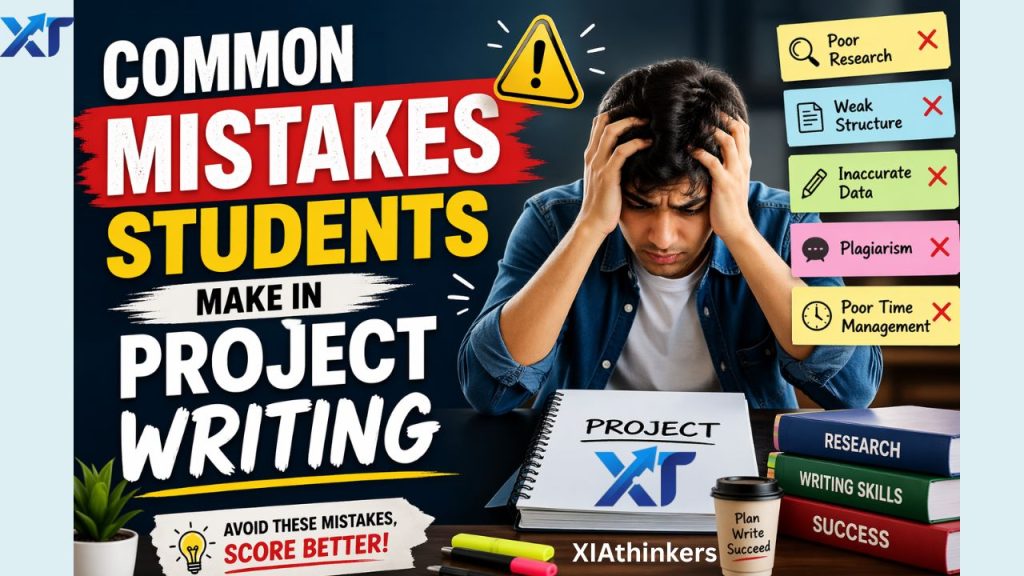
This is why understanding common project-writing mistakes is so important. Problems such as unclear research objectives, weak structure, inadequate referencing, unsupported claims, poor analysis, plagiarism, grammatical errors and failure to follow institutional guidelines can undermine an otherwise promising piece of research. Academic integrity is particularly important: the International Center for Academic Integrity identifies honesty, trust, fairness, respect, responsibility and courage as fundamental values of academic work.
The good news is that most project-writing problems can be prevented when students understand what supervisors and academic readers expect. A strong project is not necessarily the one with the most pages or the most complicated vocabulary; it is one in which the research question, evidence, methodology, analysis and conclusions fit together logically. By recognising common mistakes before submitting your work, you can improve the clarity and credibility of your project, communicate your research more confidently, and give your supervisor a much stronger piece of work to evaluate.
CHECK OUT ALSO:How to Pass JAMB 2027: The Complete Step-by-Step Guide
1. Choosing the Wrong or Unmanageable Topic
One of the first decisions that can determine how smoothly your entire project will go is the choice of topic. Many students become excited about a broad subject without first asking a more practical question: Can I actually research this topic well with the time, data, resources and skills available to me?
A topic that is too broad can quickly become overwhelming. For example, “The Impact of Technology on Education”covers such a large area that it would be difficult for an undergraduate project to examine it meaningfully. A more focused topic, such as “The Influence of Social Media Use on Academic Performance among Undergraduate Students in Selected Universities in Rivers State,” gives the researcher a clearer population, context and direction.
Research-methods literature emphasises that a good research question should provide focus and scope and should align with the problem statement, research design and analysis strategy. Vague or excessively broad questions can make detailed and rigorous analysis more difficult.
When selecting a topic, therefore, consider four things:
- Relevance: Is the topic related to your academic discipline?
- Researchability: Can you obtain reliable information or data?
- Feasibility: Can you complete the study within your available time and resources?
- Specificity: Is the topic focused enough to investigate properly?
Your personal interest also matters. A project can take months to complete, so choosing a subject that genuinely interests you can make the research process considerably easier to sustain. But interest alone is not enough—the topic must also be academically and practically manageable.
2. Copying Information from the Internet Without Understanding It
The internet has made research much easier, but it has also created a temptation that many students struggle with: copying and pasting information without critically engaging with it.
Finding a paragraph online does not mean that the information is automatically accurate, relevant or appropriate for your project. More importantly, inserting another author’s words or ideas into your work without proper acknowledgement can create plagiarism and academic-integrity problems.
A better approach is to read, understand, take notes, evaluate the source and then explain the idea in your own academic voice. When you use another researcher’s argument, statistics, findings or specific ideas, acknowledge the original source using the referencing style required by your institution.
Do not confuse paraphrasing with simply changing a few words. Genuine paraphrasing involves understanding the original idea and expressing it independently while still providing an appropriate citation.
A useful habit is to keep a research record as you work:
| Information | What to Record |
|---|---|
| Source | Author, organisation or journal |
| Publication date | Year/date published |
| Main idea | What the source contributes |
| Evidence | Important statistics or findings |
| Page/section | Where the information can be located |
| Citation | Details needed for your reference list |
This saves you from the frustrating situation of reaching the final chapter and realising that you can no longer remember where several important pieces of information came from.
3. Poor Organisation and Weak Structure
A project can contain good research and still be difficult to read if the ideas are poorly organised.
Think of your project as a journey. Your introduction should tell the reader what problem you are investigating and why it matters. The literature review should establish what previous researchers have discovered and what remains unresolved. The methodology should explain how you investigated the problem. The results should present what you found, while the discussion should explain what those findings mean.
A common problem is that students treat chapters as separate assignments rather than parts of one research argument.
A stronger project maintains a logical connection:
Research Problem → Objectives → Research Questions → Literature → Methodology → Data → Findings → Discussion → Conclusion
Research-methods guidance specifically emphasises alignment between the research question, methodology and analysis. In other words, the different parts of your project should work together rather than contradicting one another.
Before submitting a chapter, ask yourself:
“If someone reads this section, will they understand how it contributes to answering my research question?”
If the answer is no, the section may need to be reorganised.
4. Choosing a Methodology That Does Not Match the Research Question
Another serious mistake is selecting a methodology simply because it is familiar or because another student used it.
Your research question should help determine the appropriate research design and data-collection method. For example, if you want to measure the relationship between two variables across a population, a quantitative approach may be appropriate. If you want to understand people’s experiences or perceptions in depth, qualitative methods may be more suitable. Some research questions may benefit from combining both approaches.
Research-design literature stresses the importance of selecting methods that are consistent with the question being investigated, rather than working backwards from a preferred method.
Your methodology should therefore clearly explain:
- Who or what you studied.
- Where the study was conducted.
- The research design used.
- How participants or cases were selected.
- How data were collected.
- Why those methods were appropriate.
- How the data were analysed.
- Any relevant ethical considerations.
- The limitations of the chosen approach.
A strong methodology does not simply say “questionnaires were used.” It explains why the questionnaire was appropriate for the research question and how the resulting data were handled.
5. Ignoring Grammar, Formatting and Presentation
Your research may be excellent, but poor presentation can make it unnecessarily difficult for your supervisor or examiner to evaluate.
Common problems include:
- Inconsistent headings.
- Poor paragraph structure.
- Incorrect punctuation.
- Spelling errors.
- Inconsistent font sizes.
- Incorrect page numbering.
- Poorly labelled tables and figures.
- Inconsistent referencing.
- Excessive repetition.
- Sentences that are unnecessarily complicated.
This does not mean that your project needs to contain complicated vocabulary. In academic writing, clarity is more valuable than sounding impressive.
Instead of writing a long sentence simply to appear scholarly, explain the idea as clearly as possible.
Before submission, read your work slowly rather than relying entirely on a spell-checking tool. Better still, ask a classmate, colleague or supervisor to review it. A fresh reader may notice unclear sentences or logical gaps that you have become too familiar with to see.
6. Presenting Results Without Explaining What They Mean
This is one of the most important distinctions in academic research:
Presenting data is not the same as interpreting data.
Suppose your survey shows that 68% of respondents believe social media affects their study habits.
Reporting the 68% is the result.
Your discussion should then ask:
- What does this finding suggest?
- How does it answer the research question?
- Does it agree with previous research?
- If it differs from previous findings, why might that be?
- What possible explanation can be supported by the evidence?
- What are the implications of the finding?
The discussion is where you demonstrate that you understand the significance of your results.
A project should therefore move beyond:
“Table 4.2 shows that 68% of respondents agreed.”
and towards:
“The finding suggests that social-media use is perceived as an important influence on students’ study behaviour. This finding should, however, be interpreted alongside the characteristics of the sample and compared with evidence from previous studies.”
The second approach shows analysis rather than simply repeating numbers.
7. Making Claims That Your Data Cannot Support
Students sometimes become too confident when interpreting their findings.
For example, if you conduct a survey showing that students who use social media more frequently also report lower study time, you should be careful about concluding that social media causes poor academic performance.
A relationship or association between two variables does not automatically establish causation.
Good research writing distinguishes between:
- What the data demonstrate
- What the findings suggest
- What cannot be concluded from the study
This is one reason methodology matters so much. The research design determines what kinds of conclusions your evidence can reasonably support.
Research-methods literature emphasises the importance of aligning research questions, design, methods and analysis so that conclusions are appropriately supported by the study.
8. Leaving the Research Until the Last Minute
A project is much easier to manage when it is treated as a series of smaller tasks rather than one enormous assignment.
Instead of saying:
“I need to write my project.”
break the work into stages:
Topic selection → Proposal → Literature search → Research questions → Methodology → Data collection → Analysis → Drafting → Editing → Referencing → Final review
This approach also gives you time to discover problems before they become emergencies. For example, you may realise during the literature-review stage that your original research question is too broad. That is much easier to fix early than after you have collected hundreds of responses.
Research design is often iterative: as researchers learn more about the topic, they may refine their questions, design and methods.
So don’t be afraid to improve your project as your understanding develops.
9. Treating Your Supervisor’s Feedback as Criticism Rather Than Guidance
A supervisor’s comments can sometimes feel discouraging, particularly when you have already spent weeks working on a chapter.
Try to see feedback differently.
If your supervisor writes “narrow the scope,” “provide evidence,” “clarify your methodology” or “this argument needs support,” those comments are giving you a roadmap for improving the project.
Create a simple feedback tracker:
| Supervisor’s Comment | Required Action | Completed? |
|---|---|---|
| Clarify research objectives | Rewrite objectives | ✓ |
| Add recent literature | Find relevant sources | ✓ |
| Explain sampling method | Expand methodology | ✓ |
| Improve discussion | Connect findings to literature | — |
This prevents important corrections from being forgotten.
The Goal Is Not Just to Finish—It Is to Produce Credible Research
A strong academic project is not defined by its length, complicated vocabulary or number of references. Its strength comes from the quality and coherence of the research.
Your topic should be focused. Your research questions should be answerable. Your methodology should fit those questions. Your evidence should be credible. Your analysis should go beyond description, and your conclusions should remain within what your evidence can actually support.
Most importantly, start early enough to give yourself time to make mistakes, receive feedback and improve your work.
The best project is rarely the first draft. It is the result of researching carefully, writing clearly, checking critically and revising repeatedly.
When you approach your project this way, you are doing more than trying to get a good grade—you are developing the ability to think, investigate and communicate like a researcher.